BOUNDARY
Identity
Who is acting?
 CognoKratos
OPEN SOURCE · COMMUNITY BUILT · ENGINEERING CURRICULUM
They will increasingly operate software, manage resources, authorize actions and participate in financial systems. CognoKratos is the open-source engineering curriculum for building that future without surrendering security, verifiability or human control.

01 / THE TRUST PROBLEM
A more capable model does not automatically produce a more trustworthy autonomous system.
Trust comes from the architecture around it: explicit identity, narrow capabilities, deterministic policy, durable state, meaningful human authority, protected secrets and evidence that survives after the model has finished reasoning.
Read the foundationWho is acting?
What can they cause?
What is allowed?
What survives failure?
Who makes it binding?
Can we prove what happened?
Who controls the secret?
How does intent become value movement?
02 / THE LIVING CURRICULUM
The current projects are Version 1, not the permanent definition of CognoKratos. Each laboratory isolates one engineering question. The book connects them. The community extends the map as new problems emerge.
Open the canonical curriculum map
03 / REPOSITORIES ARE LABORATORIES
Every repository makes an engineering proposition through runnable code, tests, diagrams, walkthroughs and explicit limitations. They are things to inspect and challenge, not doctrine.
Intelligence does not imply authority.
Follow one request across every trust boundary.
Recoverable execution is not exactly-once execution.
Kill a run mid-flight and inspect what really survives.
The model can reason about a decision without owning it.
Trace one decision from deterministic policy to signed human approval.
Give agents capabilities, never secrets.
Follow a secret through creation, storage, derivation and zeroization.
AI capability is not financial authority.
Attack the approval boundary and prove the model cannot cross it.
Trust is an architectural property, not a model feature.
Compose identity, capability, policy, approval, cryptography and settlement into one end-to-end system.
04 / CLAIMS SHOULD BE INSPECTABLE
A reference architecture is valuable only when you can trace the boundary, reproduce the failure and verify the control. CognoKratos keeps the evidence beside the code.
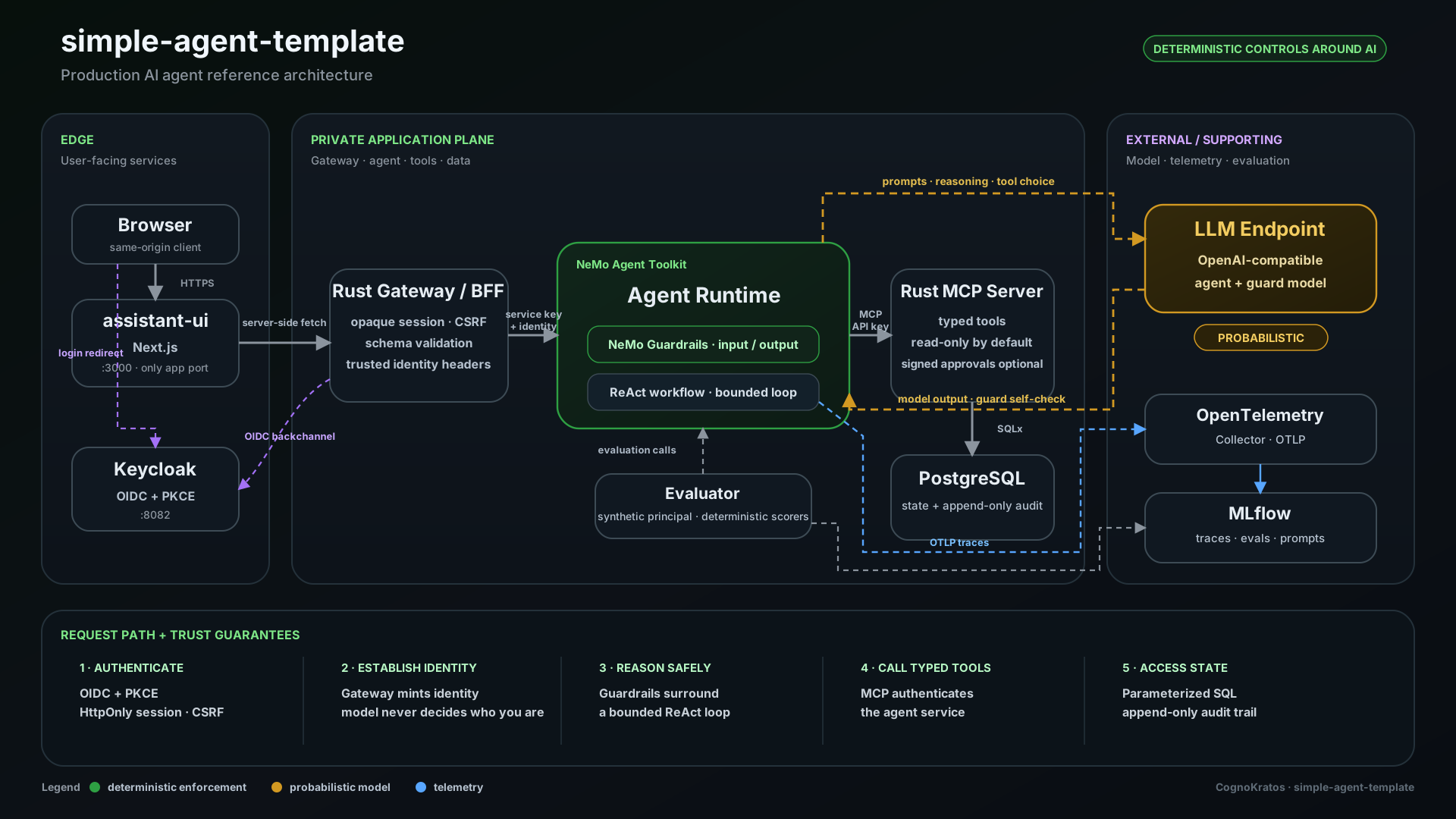
Browser, identity, gateway, probabilistic runtime, MCP tools, durable state and external model are deliberately separated.
agent → approve_invoice(...)

DENIED

policy: actor.type == :human
required_role: :approver

✓ model capability stopped
✓ domain authority heldThe interesting test is not whether the happy path works. It is whether the architecture refuses the action the model must never own.
Traces and deterministic scorers let you separate model quality from system correctness and investigate the path that produced an outcome.
05 / ONE CURRICULUM · TWO WAYS TO LEARN
The book is the textbook. The repositories are the laboratories.
Understand why the boundaries exist, compare architectures and follow a structured path across all five systems.
Read the bookRun exact implementations, break guarantees, inspect tests and traces, and adapt the systems to different domains.
Browse the laboratoriesImported book chapters name their source repository and revision, so the explanation can always be traced back to the exact code it describes.
06 / WHERE COGNOKRATOS FITS
CognoKratos is not an agent framework, a governance product, an identity protocol, a wallet SDK, a payments network or an introductory course. Excellent projects already exist for each of those.
It studies a narrower question: where does trust come from when these components are composed into systems whose actions matter?
Frameworks, clouds and protocols change faster than the properties a system depends on. The implementation may change; the engineering property should survive. Managed platforms are often the right choice, and understanding the architecture tells you which responsibilities you delegate to them and which remain yours to configure and verify.
These projects are not alternatives to CognoKratos. They solve problems it deliberately does not try to own. CognoKratos is not the box at the bottom: it teaches you how to choose and compose the boxes.
Learn the fundamentals
CognoKratos
Learn the architecture and trust boundaries
Frameworks & runtimes
Governance & policy
Protocols & infrastructure
Build your system
07 / THE OPEN FRONTIER
Autonomous economic agents create engineering problems whose answers are not settled yet. These gaps are invitations to research, experiment and contribute.
Can an agent sign a narrowly defined action without receiving unrestricted control of a private key?
How does approved intent become executed, observed and reconciled value transfer?
How can another organization verify who created an agent and what authority was delegated to it?
Which constraints should be enforced by decentralized execution instead of application policy?
How can decentralized state become trustworthy evidence for autonomous systems?
What changes when the counterparty is another autonomous actor rather than a human or API?
Know this territory better than we do?
Propose an experiment or track08 / COMMUNITY
CognoKratos is not a finished course produced by one author and consumed passively.
A contribution can be a stronger threat model, a reproducible failure, an adversarial test, a better explanation, an alternative architecture, a new experiment or an entirely new curriculum track.

FOUNDING SPONSOR
CognoKratos began as a BelaZayka open-engineering initiative and is designed to grow beyond its founders through community contribution. BelaZayka applies the resulting engineering experience commercially while keeping the curriculum and laboratories open.
About BelaZayka